
Richmond Sinus Surgeries
Your sinuses are an interconnected network of hollow cavities located near the cheekbones, in the forehead, behind the nose and between the eyes. The primary function of the sinuses is to humidify and filter the air you breathe before it enters the lungs. A small, protective layer of mucus in the sinuses helps to trap unwanted particles such as dirt, bacteria and viruses. During illness or allergies, sinuses help drain mucus out and through the nose.
Commonwealth ENT of Richmond, VA is pleased to offer sinus surgery for patients who suffer from blocked sinuses, recurrent or chronic sinus infections, abnormal growths in sinus cavities or a structural problem such as a deviated septum. Our sinus surgeries aim to treat the blockage to open and clear the pathways of the sinuses allowing patients to experience better more comfortable nasal breathing.

The Benefits of Sinus Surgery
Sinus surgeries aim to eliminate or remove the blockage in the sinus cavities to relieve the discomfort and pressure associated with chronic sinus problems. Your ear, nose and throat surgeon will likely offer other modalities of treatment for 4-6 weeks before surgery to help determine if surgery is right for you. A sinus surgery procedure can help:
- Sinuses drain more effectively thereby preventing future infections
- Remove blockages that may obstruct the free flow of air through the nasal passageways
- Create more space in the sinus cavity for better drainage and breathing
- Relieve symptoms of fullness and pressure from blocked sinuses
Types of Sinus Surgeries
Based on your medical history and examination, your doctor will help determine which type of sinus surgery can offer you the most benefit. For patients suffering with chronic sinus issues, there are several types of sinus surgeries that can help improve the quality of your life.
Endoscopic surgery is a small endoscopic tube is inserted through the nostrils to illuminate the sinus cavities and remove obstructive tissue or other blockages clearing the sinuses while restoring function.
Balloon sinuplasty is the least invasive form of sinus surgery with the shortest recovery. An endoscopic tube is inserted into the sinus, then a small balloon is passed through the tube and gently inflated once in the proper position. The balloon reshapes the sinus cavity, improving drainage, and the sinus is then flushed to remove any infected tissue.
Turbinate reduction is commonly performed during a procedure to correct a deviated septum, known as a septoplasty. The surgeon uses radiofrequency through a needle-like instrument inserted into the turbinate to shrink the tissues associated with the turbinates. This procedure improves airflow through the nose.
If you suffer from chronic sinus issues or have difficulty breathing through your nose as a result of an obstruction, Commonwealth ENT of Richmond, VA can help. Call our Richmond office (804) 525-4231 or our Midlothian office (804) 378-7443 to schedule an appointment and learn more about how sinus surgery can help you.
RICHMOND BALLOON SINUPLASTY
Balloon Sinuplasty (BSP) is a breakthrough procedure that safely and effectively cures chronic sinusitis and provides relief from recurrent sinus pain. The treatment is less invasive than traditional sinus surgery, and can be performed in our Richmond, VA office rather than at a surgical facility.
How Does it Work?
This FDA-cleared procedure uses a small, flexible, sinus balloon catheter to open up blocked sinus passageways, restoring normal sinus drainage. When the sinus balloon is inflated, it gently restructures and widens the walls of the passageway while maintaining the integrity of the sinus lining. The procedure steps are as follows:
- A balloon catheter is inserted into the inflamed sinus
- The balloon is inflated to expand the sinus opening
- Saline is sprayed into the inflamed sinus to flush out any infection and mucus
- The tool is removed and the sinuses are opened
Minimally Invasive, Easy Recovery
Balloon Sinuplasty requires no cutting or removal of nasal bone or tissue. The treatment can be completed in our office and does not require general anesthesia, saving our Richmond Balloon Sinuplasty patients money and lowering the risk of possible complications. Compared to traditional sinus surgery which requires a lengthy and delicate recovery process, Balloon Sinuplasty allows patients to return to normal daily activities within about two days. Patients report a dramatic improvement in sinus symptoms after the procedure including a reduced amount of sinus infections.
Benefits of Balloon Sinuplasty
The Balloon Sinuplasty is quickly becoming the treatment of choice for patients suffering from chronic sinusitis and restricted airflow from inflammation. Some of the benefits of the Balloon Sinuplasty procedure include:
- Safe and effective way to relieve symptoms of chronic sinusitis
- Minimally invasive approach utilizes small, flexible device to gently open the blocked sinus without surgically removing tissue or bone
- Ease of recovery with patients reporting returning to normal activities within 24 hours
- Minimal bleeding as there is no disruption to the tissue, bone or surrounding structures
- Performed in the office under local anesthesia
- No nasal packing required
If you are interested in learning more about Balloon Sinuplasty call Commonwealth ENT today at our Richmond office (804) 525-4231 or our Midlothian office (804) 378-7443.
Richmond Septoplasty
A septoplasty is a surgical procedure that aims to straighten the bone and cartilage of the nasal septum. The septum is a structure that separates the left nasal cavity from the right and when this structure is crooked it is known as a deviated septum. It is common to have a deviated septum and it can occur congenitally, as you grow through childhood, or as a result of an injury to the nose or face.
A deviated septum is one of the causes of recurrent sinusitis as it can obstruct the proper drainage of the sinuses. A deviated septum also acts as an anatomical nasal obstruction which can reduce the airflow through one side of your nose making it more difficult to breathe through that side. Often, people who snore or have sleep apnea may also have a deviated septum. Depending on the severity of the deviated septum, it can affect the quality of life for some people.
A septoplasty focuses on the inner functioning of the nasal passageways and straightens the septum to improve airflow through the nostrils. The septoplasty is performed through the nostrils and repositions the septum in the middle of your nose. Patients who have a significant deviated septum should experience improved breathing as soon as healing is complete.
Am I A Candidate for Septoplasty
At Commonwealth ENT, our board certified providers will examine your nasal passageways to help determine if a septoplasty procedure is right for you. If you struggle with chronic sinus infections, have difficulty breathing through one side of your nose, snore or have sleep apnea, a septoplasty surgery may offer long term relief of your symptoms. If you would like to learn more about how the septoplasty surgery can improve the quality of your life, call Commonwealth ENT today at our Richmond office (804) 525-4231 or our Midlothian office (804) 378-7443.
Benefits of Septoplasty
A septoplasty surgery offers many benefits for patients who have respiratory symptoms as a result of a deviated septums, including:
- Improved breathing – more airflow through both nostrils
- Improved sleep quality – maximize nasal breathing during sleep for better sleep quality
- Reduced snoring – eliminating nasal obstruction caused by deviated septum will reduce snoring and sleep apnea symptoms
- Reduced sinus infections – with the septum straightened, sinuses can drain effectively and patient may experience fewer sinus infections
Symptoms of Septal Perforation
The symptoms of a perforated septum will depend on the size of the perforation. Some can be very small and others larger.
Septal Perforation Repair
Different from a deviated septum, a septal perforation, also called a perforated septum, is a complex condition that can occur as a result of an injury or some damage that occurs to the septum. A “hole”, or perforation, develops in the septum and can cause mild to severe symptoms.
Causes of Septal Perforation
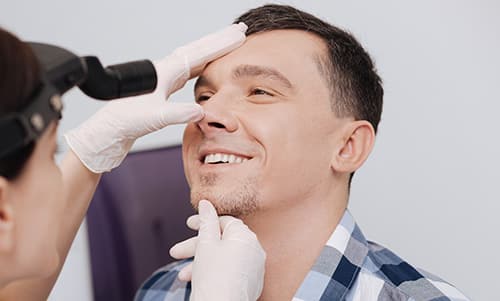
Treatment of Septal Perforation
At Commonwealth ENT, our board certified providers have years of experience and expertise in diagnosing and treating disorders of the nose. Our physicians will accurately diagnose and create a treatment plan for patients with a perforated septum. The goal is to treat the underlying cause of the perforation to reduce or eliminate symptoms.
Your doctor will start with the least invasive treatment options to reduce your symptoms such as: saline sprays to irrigate the nose, using a humidifier and applying an antibiotic ointment. A surgical technique that may work to heal the perforation is the placement of a septal button. This treatment uses a prosthesis to block or plug the hole in the nose. This is a safe procedure that can be used indefinitely to facilitate the healing of the perforation. If these treatment options do not work, it may be necessary to repair the perforation with a nasal surgery.
Our ear, nose and throat physicians at Commonwealth ENT of Richmond, VA are here to help you alleviate your symptoms with the most effective treatment options available. If you are having issues with septal perforation, we can discuss a treatment plan that will help you heal and improve the quality of your life as quickly and safely as possible.
Richmond Rhinoplasty and Nasal Reconstruction
While the purpose of a septoplasty is to improve breathing through the nasal passageways, a rhinoplasty aims to improve the aesthetics or the appearance of the nose. A rhinoplasty is a surgical procedure that can reshape, reduce or revise the way a person’s nose looks. Rhinoplasties can be performed for cosmetic purposes or as a reconstructive procedure. A nasal reconstruction surgery is performed to correct a congenital abnormality or fix a broken nose.
Structure and Function of Nose
There are two main considerations when performing a rhinoplasty surgery: structure and function. Regardless of gender, ethnicity or size, all people have the same anatomical components of the nose: cartilage, bone and skin. Dr. Matthew Bridges of Commonwealth ENT specializes in maintaining the structure of the nose during rhinoplasty surgery by a technique used to reshape the cartilage. Older techniques involved significantly reducing and removing the cartilage, which can cause problems in the future. Therefore, Dr. Bridges uses surgical techniques to retain the general cartilage structure and maintain the structural integrity of the nose.
The function of the nose is a major consideration during a rhinoplasty procedure. The nose takes air in and helps humidify it before entering the lungs. Dr. Bridges takes special care to ensure that the nose If a person has a mild deviated septum that did not cause breathing difficulties before, surgery to reduce and reshape cartilage.
Rhinoplasty Techniques
There are two approaches that can be used during a rhinoplasty procedure, an open and a closed approach. Dr. Matthew Bridges exclusively performs the closed approach at Commonwealth ENT. The open approach to rhinoplasty begins with making an incision on the skin between the nostrils. The skin is then pulled back to allow access to internal structures and the open approach also gives the surgeon improved visibility of the cartilage. This approach is more invasive than the closed approach and does cause more swelling post operatively. It may take some patients about a year for all of the swelling to fully resolve.
The closed approach begins by making an incision inside the nose only. This technique is also known as the endonasal rhinoplasty. Dr. Bridges of Richmond, VA is highly skilled and trained in the advanced closed rhinoplasty approach, or scarless rhinoplasty technique. The closed approach is more advanced and difficult; however, Dr. Bridges has spent years mastering the closed surgical technique to offer his patients the best possible results.
Rhinoplasty During/After Surgery
Rhinoplasty is usually performed under general anesthesia and is always performed in an accredited surgical facility. It is considered an outpatient procedure. After surgery, patients will wear an external splint for about 1 week. Patients may experience bruising and swelling around the nose and eyes. Bruising usually subsides over the first few weeks. Swelling decreases rapidly over the first 3-4 weeks, then slowly over many months. It can take up to a full year for the nose to gain its final contour and softness. This is more true of the open approach, as previously described above. Dr. Bridges rarely uses nasal packing. Occasionally, small plastic tubes may be placed in the nose if extensive septal work has been done.
MOHS Facial Reconstruction
Skin cancer commonly appears on the face and nose and is often removed with the Mohs surgical technique. Depending on how deep the skin cancer is, you may be concerned about the appearance of your face after surgery. While the goal of Mohs surgery is to minimize the damage to surrounding tissues, the surgical area will often need to be repaired. There are various ways you can heal after Mohs surgery depending on the depth, location and size of the wound, such as:
- Allowing the wound to heal on its own – this is usually the choice for a small skin cancer that was not deep
- Closing the wound with stitches
- Using a skin flap procedure which uses skin around the wound to cover the wound for healing
- Performing a skin graft by using skin from another area to cover the wound for healing
Dr. Bridges of Commonwealth ENT specializes in reconstructive surgery after the Mohs surgery procedure. The reconstructive plastic surgery can be performed right after the cancer is removed. Depending on the type of wound you have after the skin cancer removal, Dr. Bridges will help determine the best surgical techniques to minimize scarring after Mohs surgery.
Cosmetic Reconstruction After MOHS Surgery
The location of the lesion and the type of tissue affected are factors that determine which will be the best surgical technique for you. Dr. Bridges of Commonwealth ENT in Richmond, VA will inform you of the reconstruction options that will best suit your needs. Some surgical reconstruction techniques include:
- Flap techniques – a flap is formed from a piece of tissue that is still connected to the body with its own blood supply. Flap procedures are highly successful in facial reconstruction.
- Cartilage grafting – If your skin cancer is located on the nose, grafting donor cartilage from the ear or ribs may be necessary to complete a successful cosmetic reconstruction.
- Tissue expansion – tissue expansion is rarely required in facial reconstruction; however, it is an option if the skin cancer is large or deep.
- Skin grafting – utilizes donor tissue from the patient’s body to replace damaged or surgically excised tissue. This technique has highly successful outcomes.
If you have or are having Mohs surgery to remove skin cancer on your face, Dr. Bridges of Commonwealth ENT is double Board Certified Facial Plastic Surgeon with superior training and experience in reconstructive surgery for the face, nose and skin. If you would like to learn more about facial reconstruction after Mohs surgery call (804) 655 – 0400 today.
Surgical Treatment for Obstructive Sleep Apnea (OSA)
Obstructive Sleep Apnea, or OSA, is a common, but serious sleep disorder that is characterized by loud snoring and periods of repeated stop and start breathing during sleep. Obstructive sleep apnea occurs when the muscles in the back of the throat relax too much to support the structures in the upper airway such as the soft palate, the uvula, the tonsils and tongue. As the muscles relax, the airway narrows causing breathing to be inadequate. During this brief, usually 10 second episode, the oxygen levels in the blood can drop. As the brain senses the drop in oxygen, it rouses you from sleep so that you can reopen your airway.
If you have been diagnosed with obstructive sleep apnea, your doctor will likely recommend you use CPAP or continuous positive airway pressure to help maintain your airway during sleep. Some people tolerate a CPAP device during sleep and others may not. If you have tried a CPAP machine without luck, Commonwealth ENT can help. We offer surgical treatment options for patients with severe obstructive sleep apnea.
How Can Commonwealth ENT Help?
At Commonwealth ENT of Richmond, VA, our ear, nose and throat specialists can evaluate your nasal passages and sinuses to ensure that they are not the cause of an obstruction. A thorough examination can help identify the causes of OSA in patients and help guide your doctor to offer the most appropriate treatment options available.
If you have obstructive sleep apnea and would like to learn more about how Commonwealth ENT can help, call our Richmond office (804) 525-4231 or our Midlothian office (804) 378-7443 today.
Benign and Malignant Tumors of the Neck and Throat
Commonwealth ENT located in Midlothian and the West End of Richmond, VA offers surgical treatment options for benign and malignant tumors of the neck and throat. Our specialists work collaboratively with oncologists and care teams to ensure patients have the best treatment options and most successful outcomes.
RICHMOND ***WE’VE MOVED – NEW ADDRESS***
1501 Maple Avenue Suite 205
Richmond, VA 23226
Monday – Thursday:
8:00 AM – 5:00 PM
Friday
8:00 AM – 3:00 PM
Visit Dr. Brian Fishero, Dr. Julie Kerr & Audiologists Karasa Wilson-Scott and Erin Nichols at this office.
MIDLOTHIAN
1 Park West Circle Suite 200
Midlothian, VA 23114
Monday – Thursday:
7:30 AM – 5:00 PM
Friday
7:30 AM – 1:30 PM
Visit Dr. Matthew Bridges, Dr. Patrick Gibbons,
Audiologist Sheri Stoots & Aesthetician Franki Lambiotte at this office.